
Counting Trillions, Measuring Nothing? An analytical look at FAAC allocation, subnational performance
Muhammad Akanji
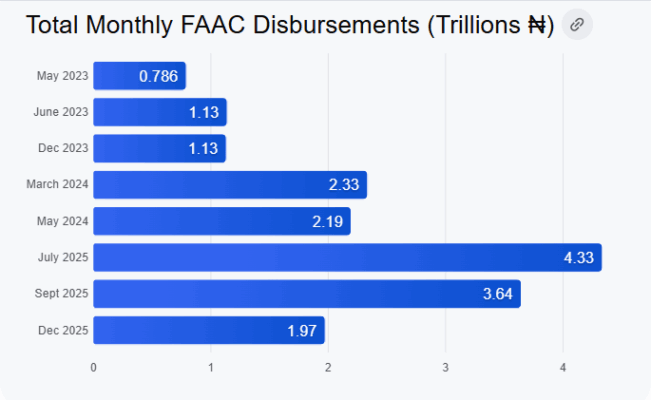
…State revenue is soaring but services stalling
…More fiscal windfalls, governance headwinds
Nigeria’s states have never been richer on paper. Between 2023 and 2025, subnational governments shared over ₦9 trillion in FAAC allocations, buoyed by the removal of the fuel subsidy, FX reforms, and higher nominal revenues. However, across much of the country, infrastructure remains broken, hospitals under-equipped, and workers unpaid.
Capital expenditure still averages below 30% of state budgets, while recurrent spending-mostly wages and overheads- absorbs the bulk of the windfall. Internally Generated Revenue (IGR) remains weak in most states, deepening dependence on federal transfers and dulling incentives for fiscal discipline. The result is an antinomy: rising allocations alongside stagnant welfare outcomes.
This disconnect raises uncomfortable questions about how public money translates- or fails to translate- into public value. If trillions in transfers cannot shift development indicators, the problem is no longer revenue scarcity but governance quality, spending efficiency and accountability. As FAAC inflows grow, so does the urgency to move beyond counting naira figures to measuring real outcomes, leading us to pose: Are Nigeria’s states building capacity and prosperity- or merely recycling windfalls without impact?
What the number says?
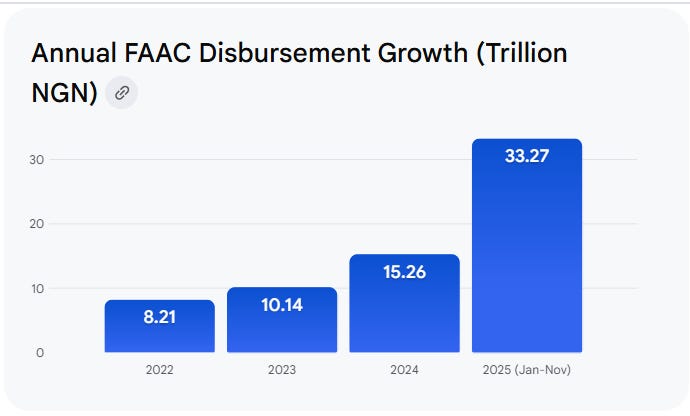
Nigeria’s FAAC receipts have surged to record highs, presenting a historic inflection point in subnational fiscal flows. According to NEITI data, total FAAC disbursements climbed from ₦8.21 trillion in 2022 to ₦10.14 trillion in 2023, and then to ₦15.26 trillion in 2024- a 66.2 percent increase over two years- driven mainly by fuel subsidy removal, FX reforms and stronger oil remittances. In 2025, the Federation Account Allocation Committee (FAAC) disbursed approximately ₦33.27 trillion; an almost double-fold increase from the 2024 figure.
State governments alone saw allocations jump from ₦3.58 trillion in 2023 to ₦5.81 trillion in 2024- a 62 per cent rise, meaning states now receive on average more than ₦480 billion monthly.
Early 2025 data also show states shared about ₦4.43 trillion in FAAC between January and July, with oil-producing states like Delta, Rivers and Bayelsa capturing large shares. Yet, the sharp uptick in public money contrasts starkly with persistent poor infrastructure and service delivery, exposing a widening allocation–impact gap that demands deeper forensic scrutiny.
Performance Reality Check
Rising FAAC allocations have not translated into commensurate improvements in service delivery across most Nigerian states. While aggregate transfers have surged into the trillions, budget execution data reveal a persistent gap between receipts and results. Capital expenditure implementation remains weak: many states execute barely 50–60% of their capital budgets annually, with recurrent spending-especially wages and overheads-crowding out development projects. Paradoxically, wage arrears and pension backlogs persist in several high-receipt states, signalling cash-flow mismanagement rather than revenue scarcity.
Infrastructure outputs tell a similar story. Road construction and rehabilitation lag budgetary promises, while power, water, and housing projects frequently stall midstream. Social indicators are even more sobering. Despite higher inflows, primary healthcare coverage remains uneven, learning outcomes in public schools are stagnant, and basic education completion rates show marginal gains at best. The evidence points to an allocation–outcome disconnect: more money is entering state coffers, but institutional capacity, project discipline, and accountability mechanisms have not scaled accordingly. The central question, therefore, is not how much states receive- but why delivery remains so stubbornly weak.
The Structural Leakages
Nigeria’s subnational fiscal paradox is not a problem of scarcity but of structure. Despite record FAAC inflows, impact remains muted because state finances are trapped in recurrent-heavy spending patterns. On average, over 65–75% of state budgets are consumed by salaries, overheads, and debt servicing, leaving limited fiscal space for capital investment. In several states, capital budget execution rates remain below 50%, even in high-revenue years.
Few states operate binding expenditure ceilings, enforce medium-term debt limits, or publish credible fiscal responsibility reports. Borrowing decisions are often disconnected from project pipelines, turning debt into a consumption-smoothing tool rather than a growth catalyst. At the same time, Internally Generated Revenue (IGR) effort remains anaemic: outside Lagos and a handful of states, IGR typically accounts for less than 20% of total revenue, reinforcing dependence on FAAC windfalls.
Accountability gaps widen the leakage. Budget transparency is uneven, procurement processes opaque, and performance reporting largely absent. Citizens can see allocations rise, but cannot trace outcomes. Without enforceable fiscal discipline, stronger subnational revenue mobilisation, and credible accountability mechanisms, FAAC trillions risk circulating within government systems—financing administration, not development—while infrastructure deficits, social services, and productivity gaps persist.
From Transfers to Outcomes
Nigeria’s fiscal federalism is overdue for a reset. FAAC has evolved into a survival lifeline for states, not a performance lever for development. Between 2020 and 2024, cumulative FAAC disbursements crossed ₦25 trillion, yet subnational outcomes—school completion rates, primary healthcare coverage, road quality, potable water access—remain stubbornly weak. The evidence is clear: money alone does not deliver development; institutions and incentives do.
Reframing FAAC as a performance instrument requires three shifts. First, conditional transparency: a defined share of allocations should be tied to timely publication of audited accounts, open-budget portals, and project-level expenditure tracking. Second, service-delivery benchmarking: states that demonstrate measurable improvements in capital project execution, basic education outcomes, primary healthcare coverage, and internally generated revenue (IGR) effort should be rewarded with performance top-ups. Third, institutional reform incentives: fiscal rules limiting recurrent spending growth, enforcing debt sustainability thresholds, and strengthening state audit and procurement systems must be embedded into allocation criteria.
This is not about punishment, but alignment. Well-designed fiscal incentives work- Brazil’s education-linked transfers and India’s reform-based grants show that conditionality can shift behaviour without eroding federal balance. For Nigeria, the central question is no longer how much is shared, but what is achieved with what is shared. Can FAAC evolve from a monthly ritual into a catalyst for accountable governance and measurable progress?
Muhammad A. Akanji is a Senior Research Fellow and Data analyst at BusinessDay Media with over a decade of experience and a keen focus on Nigeria’s macroeconomy, public finance, and development reform analytics. His writing examines the intersection of data, governance, and inclusive growth, with published analyses spanning monetary policy, fiscal transparency, and social-sector resilience. His articles provide a thought-provoking angle to socio-economic issues for private-sector executives, development practitioners, and civic organisations on navigating Nigeria’s rapidly evolving economic landscape. A keen observer of geopolitical trends and domestic policy shifts, Akanji brings a data-driven, evidence-rich approach to storytelling; bridging complex economic realities with clear, accessible insight for decision-makers and the informed public.
Business Day