
Spain country profile
Spain's economy is a thriving, highly developed social market economy, the world's 12th largest by nominal GDP.
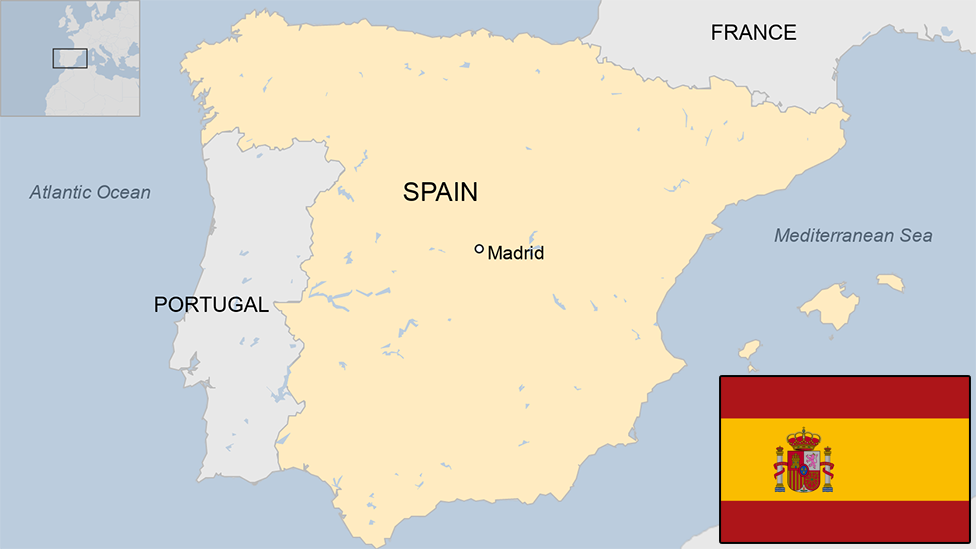
Spain's location at the crossroads of the Atlantic and the Mediterranean, Europe and Africa, has made it a key political and cultural bridge across five continents.
Through exploration and conquest, Spain became a world power in the 16th Century, and maintained a vast overseas empire until the 19th Century.
Its modern history was marked by the bitter civil war of 1936-39, and the ensuing decades-long dictatorship of Francisco Franco.
Since General Franco's death in 1975, Spain has made the transition to democracy, and built a modern economy.
The country's 17 regions have their own directly-elected authorities, but separatism remains a live issue in wealthy Catalonia in the north-east.
KINGDOM OF SPAIN: FACTS
Capital: Madrid
Area: 505,990 sq km
Population: 47.1 million
Language: Spanish
Life expectancy: 79 years (men) 85 years (women)
LEADERS
Head of state: King Felipe VI
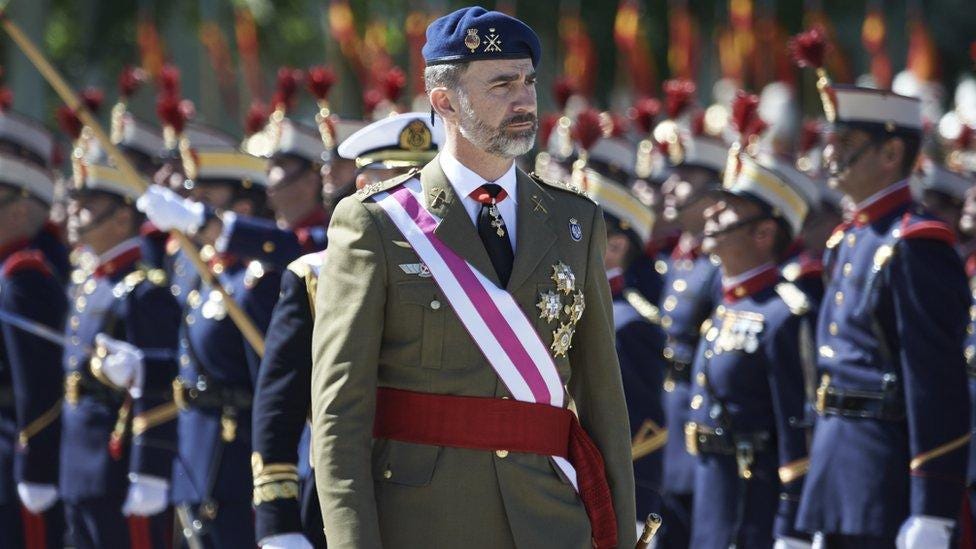
Image caption,
King Felipe is the second monarch to reign since the restoration of democracy
King Felipe succeeded to the throne on the abdication of his father Juan Carlos in June 2014.
Born in 1968 when his father was heir-apparent to the vacant throne during the Franco dictatorship, Prince Felipe was educated for his future royal role and undertook official engagements on behalf of the king from 1995.
Despite retaining considerable constitutional power as chief executive and commander-in-chief, King Felipe has pledged to continue his father's legacy of supporting the primacy of parliament.
Prime Minister: Pedro Sánchez
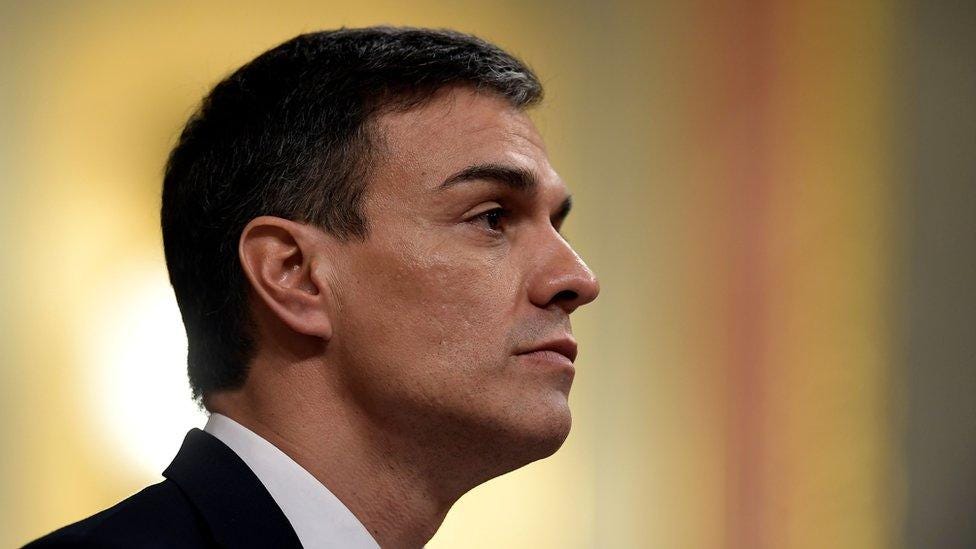
Image caption,
Mr Sánchez has struggled with a lack of parliamentary support
Socialist leader Pedro Sánchez took over as prime minister in June 2018, after his conservative predecessor Mariano Rajoy lost a parliamentary vote of confidence.
This was triggered by a long-running corruption trial involving members of Mr Rajoy's Popular Party.
Snap elections in April and November 2019 boosted the Socialists, but they fell short of a majority, while Vox became first far-right party to win seats since the death of Francisco Franco in 1975.
In January 2020, Mr Sánchez formed a minority coalition government with the left-wing Podemos party after winning a narrow parliamentary vote of confidence.
MEDIA
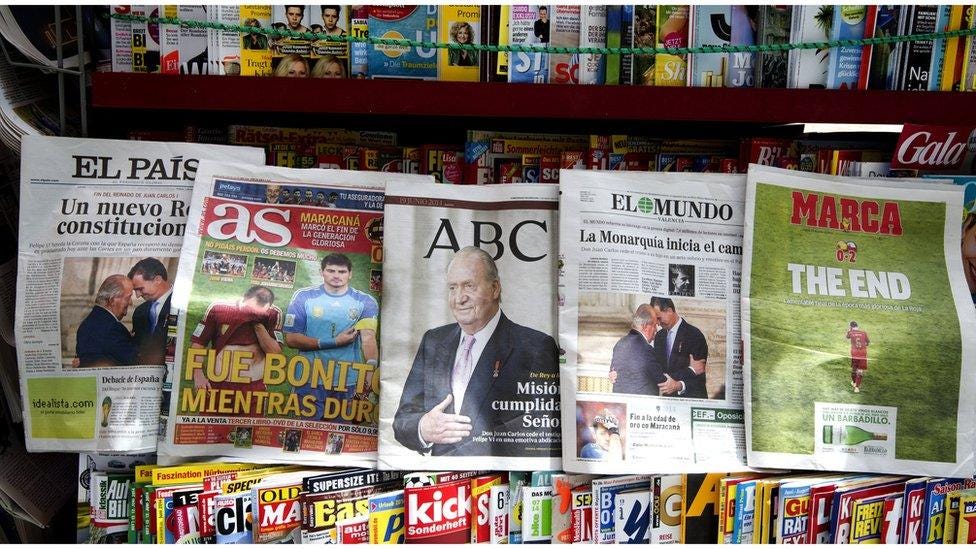
Public broadcaster RTVE shares the market with major commercial operators. Regional TV networks are operated by their respective governments.
Freedom House NGO raises concerns about the concentration of media ownership and what it says is political interference in public media.
TIMELINE
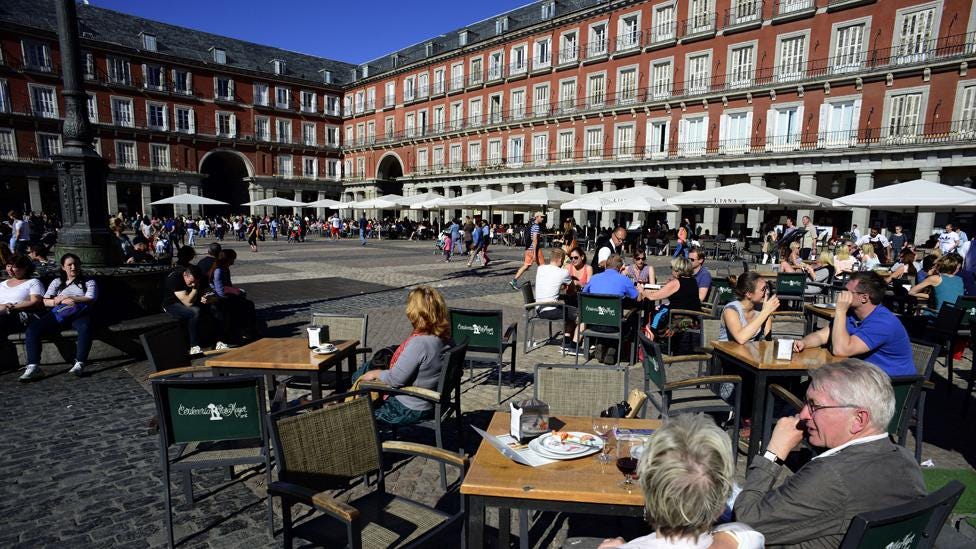
Image caption,
Madrid's Plaza Mayor
Some key dates in Spain's history:
1492 - The Christian kingdoms of Castile and Aragon conquer the emirate of Granada, ending nearly 800 years of Muslim rule in the peninsula and founding modern Spain as a united state.
1492 - Christopher Columbus arrives in the Americas, heralding the conquest of much of South and Central America.
16th Century - Jews and later Muslims are expelled from Spain during the Inquisition.
16th-17th Centuries - Spanish Empire at its height, with Spain the predominant European power. The rise of Protestant states in northern Europe coupled with struggles with the Ottoman Empire in the Mediterranean see the country's gradual decline.
18th Century - The War of the Spanish Succession: Spain loses its European possessions outside the Iberian peninsula.
The Bourbon dynasty, originally from France, centralises the Spanish state, shutting down many regional autonomous assemblies and modernising government and the military.
1807-1814 - Napoleon's France occupies Spain, which had been a French satellite since 1795. Fierce nationalist resistance and British intervention in the Peninsular War gradually forces French troops out.
19th Century - Napoleonic legacy of political division and economic dislocation leaves Spain weak and unstable, with frequent changes of government and a low-level insurgency by Carlist supporters of a rival branch of the royal family.
All Latin American colonies win their independence, with Cuba, Puerto Rico and the Philippines in Asia lost during a disastrous war with the United States in 1898.
1910s - Spain seeks compensation in conquering colonies in Africa, most significantly northern Morocco and the Spanish Sahara.
1920s - The trade boom achieved by neutrality in World War One is squandered through fighting Moroccan rebels in the Rif War 1921-26 and the financial mismanagement of the Primo de Rivera dictatorship at home.
1931 - The return of democratic government leads to an electoral backlash against the monarchy and its allies, and a republic is declared. Radical policies of land reform, labour rights, educational expansion and anti-Church legislation deepen the political divide.
1936 - After two years of right-wing government, a Popular Front coalition of left-wing and liberal parties narrowly wins parliamentary elections and seeks to reintroduce the radical policies of 1931.
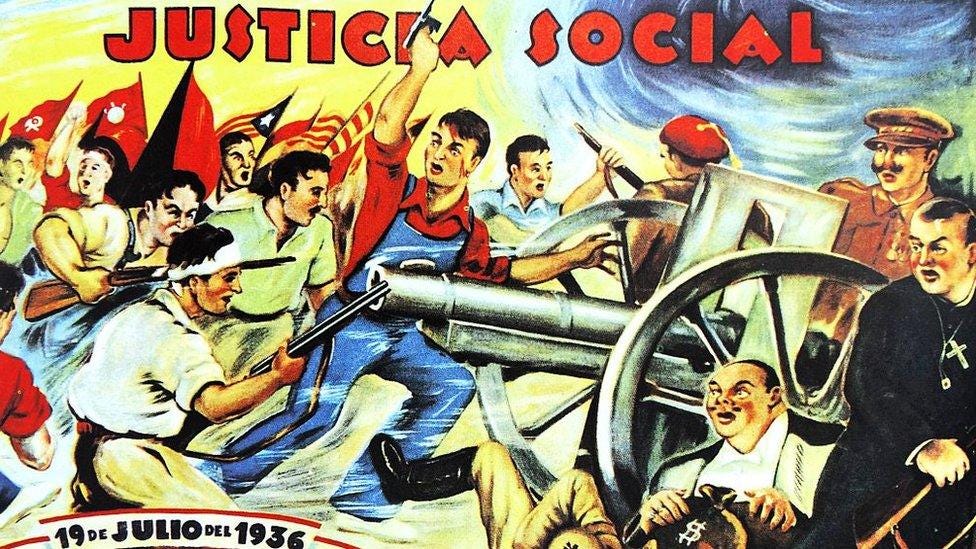
Image caption,
Republican propaganda poster from the outbreak of the Spanish Civil War in July 1936
1936-39 - Spanish Civil War: A coup by right-wing military leaders captures only part of the country, leading to three years of bitter civil war. More than 350,000 Spaniards die in the fighting. Italy and Nazi Germany intervene on the side of the Nationalists. The USSR aids the Republicans.
1939-45 - Spain remains neutral throughout World War Two, although the government is sympathetic to the Axis powers.
1946-50 - Francoist Spain is ostracised by UN and many countries sever diplomatic relations.
1950s - As the Cold War deepens the US gradually improves relations with Spain, extending loans in return for military bases.
1955 - Spain joins the UN
1958 - Spain joins the World Bank. European countries open up to the Franco government.
Late 1950s - El Milagro Español - the economic miracle sees manufacturing and tourism take off through liberalisation of state controls.
1959 - The Eta armed separatist group is founded with the aim of fighting for an independent Basque homeland.
1973 - Eta kills Prime Minister Admiral Luis Carrero Blanco in retaliation for the government's execution of Basque fighters.
1975 - Franco dies. Succeeded as head of state by King Juan Carlos. Spain makes transition from dictatorship to democracy and withdraws from the Spanish Sahara, ending its colonial empire.
1977 - First free elections in four decades.
1978 - New constitution confirms Spain as a parliamentary monarchy.
1981 - Right-wing coup attempt fails after King Juan Carlos makes a televised address demanding the plotters surrender.
1986 - Spain joins European Economic Community, later to become the European Union.
2002 - Spain adopts the euro.
2004 - 191 people are killed in bomb blasts on rush-hour trains in Madrid in near-simultaneous pre-election attacks by an Islamic group with links to al-Qaeda.
2005 - Parliament legalises gay marriage.
2012 - Eta says it is ready to disband, disarm and enter talks with the French and Spanish governments.
2014 - King Juan Carlos, abdicates in favour of his son, Felipe VI.
2017 - Madrid imposes direct rule in Catalonia after a referendum backs independence from Spain.
2018 - Basque separatist former armed group Eta announces it is ceasing all political activities.
2019 - Franco's remains are exhumed from the Valley of the Fallen and reburied with his wife in a Madrid cemetery, as part of efforts to remove all public veneration of his dictatorship.
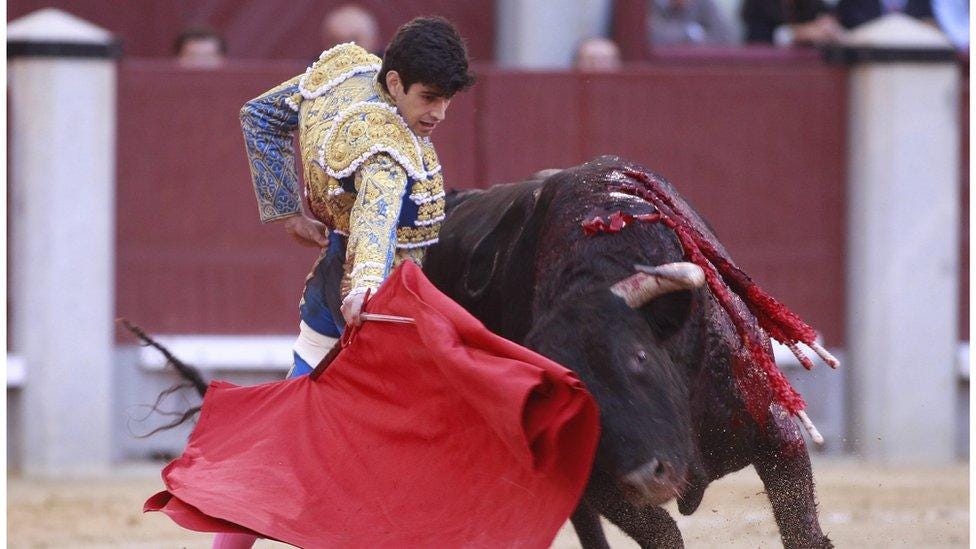
Image caption,
Bullfighting is a controversial part of Spain's cultural heritage
The BBC
Overview
Economy
Spain's economy is a thriving, highly developed social market economy, the world's 12th largest by nominal GDP. It is a significant player in Europe, holding the fifth-largest economy position, excluding Russia. The country's economic performance is impressive, with robust domestic demand, strong tourism, and government support contributing to its growth. Notably, Spain's economy grew by 3.2% in 2024, exceeding many of its European counterparts.
Here's a more detailed look at the Spanish economy:
Key Strengths:
Strong Domestic Demand:
A key driver of Spain's economic growth is its robust domestic demand, indicating healthy consumer spending and investment within the country.
Tourism Powerhouse:
Tourism is a major contributor to the Spanish economy, with the country being the second most popular tourist destination globally.
Government Support:
The Spanish government has implemented policies and reforms that have fostered economic growth and job creation.
Balanced Economic Model:
Spain has successfully adopted a balanced economic model that capitalizes on its strengths, leading to record job creation, higher productivity, and a substantial current account surplus.
Dynamic Labor Market:
A 2021 labor reform broadened permanent hiring options, contributing to a robust labor market and record job creation.
Green Economy Leader:
Spain is recognized as one of the world's greenest economies, attracting foreign investment.
Key Economic Indicators:
GDP: Spain's nominal GDP is around $1.799 trillion (2025 estimate).
GDP Growth: The Spanish economy grew by 3.2% in 2024.
GDP per capita: Spain's GDP per capita surpasses that of Japan.
Exports: Spain is the 18th-largest exporter in the world.
Imports: Spain is the 15th-largest importer in the world.
Unemployment: Spain has seen significant job creation, including a large number of foreign-born workers.
Challenges:
High Public Debt:
Despite its strengths, Spain faces challenges related to high fiscal deficits and public debt.
Aging Population:
An aging population could pose challenges to Spain's long-term economic growth.
Political Polarization:
A highly polarized political landscape can hinder economic growth potential.
Overall:
Spain's economy is experiencing a period of strong growth and transformation, fueled by a combination of factors including a thriving tourism sector, a dynamic labor market, and government support. While challenges remain, Spain is well-positioned to continue its positive economic trajectory.